
Adderall is one of the most widely prescribed medications in the United States, and for people with ADHD it can be genuinely useful. It is also a stimulant with real risks, and those risks tend to get less attention than they deserve, partly because a prescription makes a medication feel inherently safe.
This article covers the side effects associated with Adderall, how physical dependence develops, what happens when someone stops taking it, and the point at which stimulant use becomes something that needs treatment rather than adjustment.
Nothing here is medical advice, and it is not a reason to change or stop a prescribed medication. Decisions about prescribed medication belong with the prescribing clinician.
What Adderall Is and How It Works
Adderall is a prescription stimulant containing a combination of amphetamine salts. It is prescribed primarily for attention deficit hyperactivity disorder and, less commonly, for narcolepsy.
The medication increases activity of dopamine and norepinephrine in the brain. For someone with ADHD, this tends to produce improved focus and reduced impulsivity. The effect people describe is not usually euphoria but rather a sense of the mind becoming quieter and easier to direct.
Adderall is classified as a Schedule II controlled substance in the United States. That classification exists because the medication has recognised medical value alongside a recognised potential for dependence and misuse. Understanding that both things are true at once is the starting point for everything else on this page.
What Adderall Does to Someone Without ADHD
This is one of the most common questions about the medication, and the answer differs from what many people expect. Someone without ADHD who takes Adderall usually experiences stimulation, wakefulness, increased confidence, and often a sense of heightened energy, but not the settling effect that people with ADHD describe.
That difference matters, because the stimulating and mood-elevating effect is the one associated with repeated use and escalation. Use without a prescription carries substantially more risk of dependence than prescribed use taken as directed.
Common Adderall Side Effects
Most people taking Adderall as prescribed experience some side effects, particularly in the early weeks. Common ones include:
Reduced appetite and unintended weight loss
Difficulty falling asleep or staying asleep
Dry mouth
Headache
Increased heart rate
Raised blood pressure
Anxiety, jitteriness, or restlessness
Irritability, particularly as the dose wears off
Nausea or stomach discomfort
Sweating
Many of these ease over time or respond to adjustments made by the prescribing clinician. Persistent or worsening side effects are worth raising with that clinician rather than managing alone.
Effects on Mood and Personality
People close to someone taking Adderall sometimes describe changes in personality: increased irritability, emotional flatness, or a shorter fuse than usual. This is a recognised effect rather than an imagined one. Stimulants can blunt emotional range, and the drop-off as the medication wears off frequently brings low mood and irritability with it.
Effects Reported More Often by Women
Some side effects of Adderall in women are reported more frequently, including changes to menstrual cycle regularity and variation in the medication's effect across the cycle, since hormonal fluctuations appear to influence how stimulants are experienced. Appetite suppression and associated weight loss are also reported more commonly.
Sexual Side Effects
Adderall sexual side effects are common but rarely discussed. Reported effects include reduced libido, difficulty with arousal, and difficulty reaching orgasm. These affect people of any gender and are one of the more frequent reasons people quietly stop taking a prescribed stimulant without telling anyone.
Effects on Skin and Appearance
Longer-term stimulant use can produce visible changes: weight loss that becomes noticeable in the face, dry or dull skin, dental problems related to dry mouth and grinding, and the tired appearance that follows chronic sleep disruption.
Long-Term Effects of Adderall
Long-term effects of Adderall are less well documented than short-term ones, particularly for people using the medication outside a prescription. Areas of established concern include:
Cardiovascular strain from sustained elevation in heart rate and blood pressure
Chronic sleep disruption, which affects mood, memory, and immune function
Ongoing appetite suppression leading to nutritional deficits
Increased anxiety, and in some cases panic symptoms
Mood instability, including depressive episodes
Reduced effect over time as tolerance develops
Tolerance deserves particular attention because of what tends to follow it. As the same amount produces less effect, the natural response is to take more. When that happens outside clinical supervision, it is the most common route from prescribed use into problematic use.
Adderall and Mental Health
Anxiety
Adderall does not treat anxiety, and for many people it makes anxiety worse. As a stimulant it increases physiological arousal, which can amplify anxiety symptoms directly. Some people with ADHD do report reduced anxiety on the medication, usually because untreated ADHD was generating the anxiety in the first place, but Adderall is not an anxiety treatment and is not prescribed as one.
Depression
Adderall can contribute to depressive symptoms in two ways. The daily drop as the medication wears off often brings a period of low mood and fatigue. More significantly, extended heavy use followed by stopping is frequently associated with a period of depression as the brain readjusts to functioning without elevated stimulant activity.
Stimulant Psychosis
At high amounts, and particularly with sustained use without sleep, stimulants can produce psychotic symptoms including paranoia, hallucinations, and delusional thinking. This is uncommon at prescribed levels but is a recognised risk with heavy misuse. It requires immediate medical attention.
Adderall and Alcohol
Mixing Adderall and alcohol is common and carries specific risks that are easy to underestimate.
The central problem is masking. Stimulants reduce the subjective sense of intoxication, so a person drinking on Adderall often does not feel as drunk as they are. That leads to drinking considerably more than intended, which raises the risk of alcohol poisoning and of decisions made while far more impaired than the person realises.
There is also a cardiovascular dimension. Both substances place demands on the heart, and combining them increases strain. Regularly combining stimulants with alcohol is a pattern worth taking seriously rather than treating as ordinary.
How Adderall Dependence Develops
People often ask whether Adderall is addictive. The accurate answer is that it can be, and the way that happens is usually gradual rather than dramatic.
A typical progression looks like this. The medication works well initially. Over months, the same amount produces less effect as tolerance builds. The person begins taking a little more, or taking it on days it was not intended for, or using it to manage workload and fatigue rather than the symptoms it was prescribed for.
At some point, functioning without it starts to feel impossible. Ordinary tasks feel unmanageable on days without the medication. That shift, from the medication helping with a specific difficulty to being required for baseline functioning, is where dependence sits.
Signs of Adderall Addiction
Signs worth paying attention to include:
Taking more than prescribed, or taking it more often than prescribed
Running out of a prescription before the refill is due
Obtaining the medication from sources other than a prescribing clinician
Feeling unable to work, study, or socialise without it
Continuing to use it despite clear negative effects on sleep, mood, or health
Unsuccessful attempts to cut down or stop
Anxiety about running out, or planning around supply
Concealing the extent of use from family, friends, or clinicians
Dependence and addiction are not identical. A person taking Adderall exactly as prescribed can develop physical dependence, meaning the body has adapted and stopping produces withdrawal. Addiction involves the loss of control over use and its continuation despite harm. Physical dependence alone, under clinical supervision, is not addiction.
Adderall Withdrawal
Stopping Adderall after regular use produces withdrawal, commonly known as the crash when it follows heavy use over a short period.
Adderall withdrawal symptoms typically include:
Severe fatigue and lack of energy
Sleeping far more than usual, often with poor sleep quality
Low mood, sometimes reaching significant depression
Difficulty concentrating
Increased appetite
Irritability and agitation
Vivid or unpleasant dreams
Strong cravings
Adderall Withdrawal Timeline
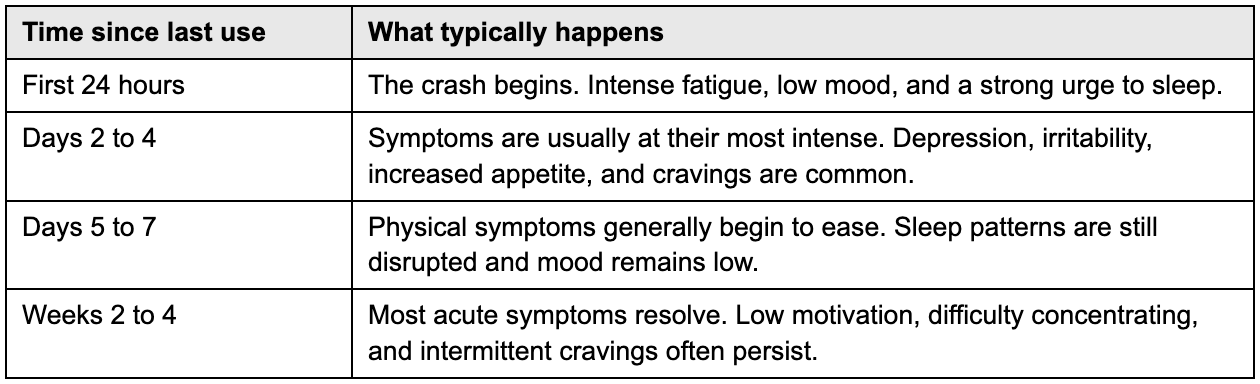
Adderall withdrawal is not usually physically dangerous in the way alcohol withdrawal can be. The main risk is the depression that accompanies it, which can be severe enough to require support, and which is a common reason people return to use.
Anyone taking prescribed Adderall who wants to stop should discuss it with their prescribing clinician rather than stopping abruptly on their own.
Adderall Overdose
Overdose is possible, particularly when the medication is used outside a prescription or combined with other substances. Signs requiring emergency medical attention include:
Chest pain
Difficulty breathing
Irregular or extremely rapid heartbeat
Confusion or disorientation
Hallucinations or severe agitation
Seizure
High fever
Loss of consciousness
If these appear, call emergency services immediately.
When to Seek Treatment
Prescription stimulant use disorder is treatable, and treatment does not require a person to have reached a crisis point first.
Treatment is worth considering when use has moved beyond what was prescribed, when attempts to stop have not worked, when the medication is being obtained outside a clinical relationship, or when use is continuing despite clear harm to health, work, relationships, or finances.
Treatment for stimulant dependence generally focuses on behavioural approaches, since there is no equivalent of substitution therapy for stimulants. Cognitive behavioural therapy, structured support, and treatment of any underlying ADHD, anxiety, or depression all form part of it. Where ADHD is genuinely present, addressing it properly is often central to a durable outcome.
Prescription Stimulant Treatment in Idaho
The Walker Center is a non-profit addiction treatment provider that has served Idaho since 1976, with residential services in Gooding and outpatient services in Twin Falls. Programs are CARF-accredited and delivered by licensed and certified professionals, and include care for co-occurring mental health conditions.
If you are uncertain whether stimulant use has become a problem, a confidential assessment is a reasonable place to start. Our team can explain program options and payment arrangements.
Call 1-800-227-4190 to speak with our team.
FAQs
Is Adderall addictive?
It can be. Adderall is a Schedule II controlled substance with recognised potential for dependence and misuse. Risk is considerably higher when it is used without a prescription or in amounts beyond those prescribed.
What are the most common Adderall side effects?
Reduced appetite, difficulty sleeping, dry mouth, headache, increased heart rate, raised blood pressure, and anxiety or irritability are among the most frequently reported.
What does Adderall do to someone without ADHD?
It usually produces stimulation, wakefulness, and increased energy and confidence, rather than the settling and focusing effect people with ADHD describe. This is one reason non-prescribed use carries higher dependence risk.
How long does Adderall withdrawal last?
Acute symptoms usually peak within 2 to 4 days and ease over the first week. Low motivation, poor concentration, and cravings can continue for several weeks.
Can Adderall cause depression?
Yes. Low mood commonly accompanies the daily wearing-off period, and a more sustained depressive period is common after stopping following heavy use.
Does Adderall help with anxiety?
No. Adderall is not prescribed for anxiety and frequently increases it. Some people with ADHD report less anxiety on the medication because untreated ADHD was contributing to it.
Is it safe to drink alcohol while taking Adderall?
Combining them is risky. Stimulants mask the sense of intoxication, which commonly leads to drinking more than intended, and both substances increase strain on the heart.
What are the long-term effects of Adderall?
Areas of concern include cardiovascular strain, chronic sleep disruption, nutritional deficits from appetite suppression, increased anxiety, mood instability, and tolerance.